Guide 6 of 15 to opening a gym · Set up
Equipment list to open a box or studio
Equipment for a new training space is bought in three layers. First, what each person uses at the same time in your biggest class, multiplied by that class's spots. Then what is shared on rotation, such as ropes, rings and rowers. Finally the specialist kit that only some classes use, which can wait until the timetable grows. This guide gives the list by modality: CrossFit and functional fitness, hybrid training, small-group strength, Pilates and yoga. For each one, it separates what to buy to open from what can wait.
On this page · 17 sections
- 1.The three-layer rule
- 2.CrossFit and functional fitness
- 3.Hybrid training and HYROX preparation
- 4.Small-group and strength training
- 5.Pilates
- 6.Yoga
- 7.What every space needs
- 8.Test the list before ordering
- 9.Quantities for a class of twelve
- 10.Ordering, delivery and installation
- 11.New or second-hand
- 12.Equipment for the beginners class
- 13.Maintenance and records
- 14.The shopping list, by biggest class
- 15.The mistakes that cost the most
- 16.With Rummo
- 17.Frequently asked
The three-layer rule
| Layer | What it is | How much to buy |
|---|---|---|
| Per spot | What each person uses at the same time | One per spot in the biggest class |
| Shared | What is used in rotation or stations | Enough that the rotation never stalls |
| Specialist | What only some classes use | When the timetable asks for it |
Before opening any catalogue, write three or four workouts for the first week, as if you were coaching them tomorrow. The shopping list comes from those. Anything that does not appear in the first weeks of workouts can wait.
CrossFit and functional fitness
To open
- Olympic barbells, men's and women's, one per spot, with collars for each.
- Bumper plates you can drop, in pairs, at the loads your classes use most.
- Light technique plates for people who are learning.
- A pull-up rig with squat stands, with stations for the whole class.
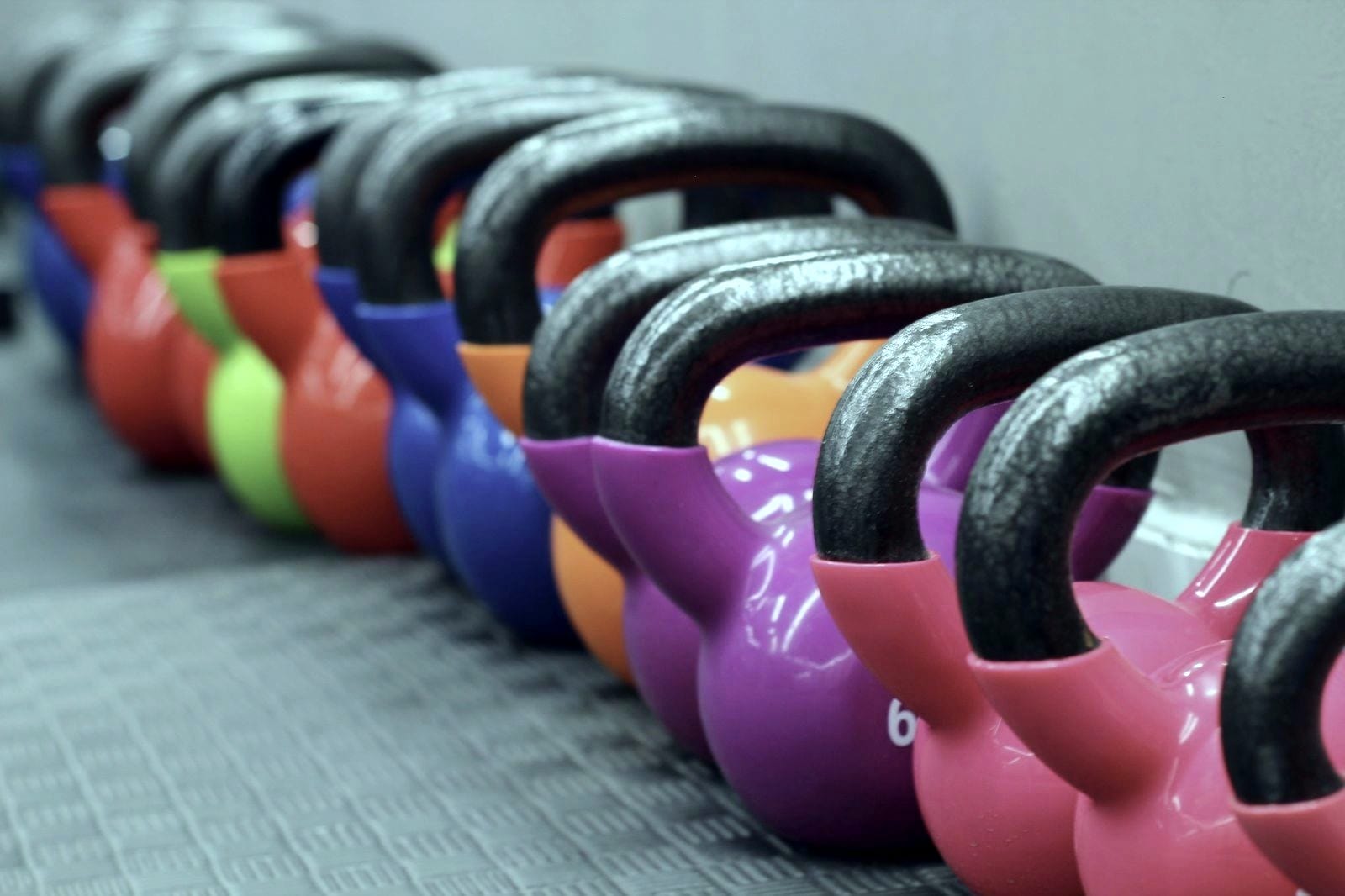
- Kettlebells and dumbbells across a range of weights, with repeated pairs in the middle weights.
- Plyo boxes, ideally soft foam, which are kinder to shins.
- Medicine balls for wall balls, and a wall target.
- Air rowers or air bikes, enough for a rotation without queues.
- Skipping ropes and pull-up assistance bands.
- Rubber flooring, with platforms in lifting areas.
- An interval clock visible from the whole room, a whiteboard and a sound system.
Later, as the timetable grows
- Extra rings and climbing ropes.
- Ski ergs and back extension benches.
- A sled, sandbags and carry handles.
- Heavy dumbbells and specialty bars.
- More rowers or bikes, once the rotation starts to queue.
Hybrid training and HYROX preparation
The official race has eight stations, always in the same order: ski erg, sled push, sled pull, burpee broad jumps, row, farmers carry, sandbag lunges and wall balls. There is one kilometre of running before each station.
- To open: rowers, ski ergs and air bikes in enough numbers for queue-free rotations.
- To open: kettlebells or farmers handles, sandbags, medicine balls and a target.
- To open: a safe running loop around the building, or treadmills.
- Later, or at opening if the space allows: sleds with a long enough artificial turf track.
What changes in a hybrid training gym, from timetable to stations, has its own guide.
Small-group and strength training
- To open: full racks, one for every two or three people in the group, with barbells and benches.
- To open: enough plates for the group's heaviest lifts, and dumbbells in pairs.
- To open: platforms, if you teach Olympic lifting.
- Later: cable machines, presses and rehab equipment.
Pilates
Pilates splits into two business models. Mat Pilates uses light equipment and supports bigger groups. Reformer Pilates uses machines, and the class capacity is the number of reformers.
- Mat, to open: thick mats, small balls, rings, bands, blocks and rollers.
- Reformer, to open: reformers, one per spot, with walking space around each.
- Reformer, later: tower or cadillac, chair and barrel, for private sessions and duets.
Yoga
- To open: mats, blocks, straps, bolsters and blankets, one set per spot.
- To open: controllable heating and ventilation, if you run heated classes.
- Later: chairs and restorative props for special classes.
What changes in a Pilates or yoga studio, from group sizes to class packs, has its own guide.
What every space needs
- Storage: racks for barbells, plates, balls and mats. A tidy room is safer and faster between classes.
- A first aid kit, in a place the whole team knows.
- Cleaning and disinfecting supplies for shared equipment.
- A tablet at the entrance for QR code check-in.
- Sound that carries over the noise of a class, and a microphone if the room is large.
Test the list before ordering
Take the first week of workouts and go through them one by one with the list beside you. For each exercise, ask three things. How many people do it at the same time? Is there equipment for all of them, or for the rotation? Is there a lighter version for beginners? Every no is a line to add. Every item no workout used is a line to postpone.
Do the same for the beginners class. It is the class that runs short of light loads, technique bars and low boxes, because nobody thought of it when ordering.
Quantities for a class of twelve
For a box whose biggest class has twelve spots, the first layer looks like this. These are quantities, not prices, because prices vary too much between suppliers.
| Equipment | Per spot | For twelve spots |
|---|---|---|
| Barbell with collars | 1 | 12, mixing men's and women's bars |
| Pairs of everyday plates | 1 to 2 | 12 to 24 pairs |
| Light technique plates | For learners | A few pairs |
| Middle-weight kettlebell or dumbbell pair | 1 | 12 |
| Plyo box | 1 | 12 |
| Medicine ball | 1 | 12, with a wall target |
| Rower or air bike | Shared | What the rotation needs without queues |
Ordering, delivery and installation
- Get the delivery date in writing. Equipment that arrives after opening does not exist on day one.
- Order the flooring first. Everything else goes on top of it.
- The pull-up rig is fixed to the floor or wall. Confirm with the landlord and the installer.
- Keep invoices and manuals. You need them for warranties, insurance and your own procedures.
- Install everything before the test classes, not the night before opening.
New or second-hand
Anything without moving parts takes well to a second life: barbells, plates, kettlebells, dumbbells, boxes and rigs. Machines with chains, fans and monitors need more care. Before buying second-hand, test the monitor, listen to the chain, and ask about age and servicing.
For a rower or an air bike, check the space it needs in use, too. The maker of one air rower lists 274 by 122 centimetres for use, more than the machine itself takes up.
Equipment for the beginners class
Beginners need lighter versions of everything: technique bars, light plates, low boxes, lighter kettlebells and medicine balls, and bands for pull-ups. If the beginners class shares the room with a regular class, these come on top of the per-spot count, not instead of it.
Maintenance and records
Keep an equipment sheet from day one: what, how many, where it is, when it was last serviced. It helps with insurance, with buying replacements, and with any inspection. Some countries also require written procedures for equipment use. Portugal, for example, requires an operations manual that covers it.
Equipment | Quantity | Supplier | Purchase date | Last service | Next service | Notes
Air rower | ___ | ___ | ___ | ___ | ___ | chain, monitor, saddle
Barbells | ___ | ___ | ___ | ___ | ___ | sleeve spin, rust
Pull-up rig | ___ | ___ | ___ | ___ | ___ | bolts, floor fixing
Ropes and rings | ___ | ___ | ___ | ___ | ___ | wear, anchor points
The shopping list, by biggest class
Biggest class on the opening timetable: ______ spots.
Per spot (× spots): ______
Shared (queue-free rotation): ______
Flooring, platforms and storage: ______
Clock, sound, whiteboard and entrance tablet: ______
Specialist (postponed until ______): ______
The timetable decides the equipment. Buying before the timetable exists is buying for a catalogue.
The mistakes that cost the most
- Buying specialist kit before the basics. A premium machine does not make up for twelve missing barbells.
- Forgetting storage. Kit on the floor wastes time between classes and causes accidents.
- Buying only heavy weights. Beginners need light loads, and those are what run out.
- Counting the machine's footprint without its space in use.
- Leaving no budget for what breaks in the first months.
With Rummo
Class mode is the coach's screen during class: who has arrived, the session plan in blocks and the results area. Blocks run from warm-up to strength, conditioning, running and stations. The door screen shows a QR code on a tablet that changes every 30 seconds.
Frequently asked
- What equipment do I need to open a CrossFit gym?
- To open, whatever your biggest class uses at once: barbells, plates, a rig, kettlebells, boxes, medicine balls, and rowers or bikes for rotation. Add rubber flooring, a visible clock and sound. Buy the rest as the timetable grows.
- How many barbells do I need?
- One per spot in your biggest class, if that class lifts. Twelve spots means twelve barbells, with a mix of men's and women's bars.
- Is second-hand gym equipment worth buying?
- For anything without moving parts, yes: barbells, plates, kettlebells, boxes and rigs. Inspect machines before buying: monitor, chain and service history.
- What equipment does a Pilates studio need?
- For mat Pilates, mats and light props. For reformer Pilates, one reformer per spot with space around it. Tower, chair and barrel can wait for private sessions.
- What do I need to train people for HYROX?
- Rowers, ski ergs, sandbags, carry weights, medicine balls with a target, and somewhere to run. A sled with a track is the hardest to fit and can come later.
- How should I track equipment maintenance?
- With one sheet per item type: quantity, purchase date, last and next service. It pays off with insurers, replacements and inspections.
- What should I buy for a beginners class?
- Light loads, technique bars and low boxes. That is the class that runs short, because orders get planned around regular classes.
Sources
- The Fitness Race: race format · HYROX, 2026
- RowErg: dimensions and space required · Concept2, 2026
Rummo team
Written by the people who build Rummo, management software for gyms, boxes and studios: classes, bookings, members and payments.
Reviewed
Opening soon? Set up your week before day one.
Create your space, classes and plans, and members book from their phones. The 9 first-week steps take about 31 minutes.
Lite is free up to 10 active members, with no card and no time limit. Pro comes with a 14-day trial, also with no card.